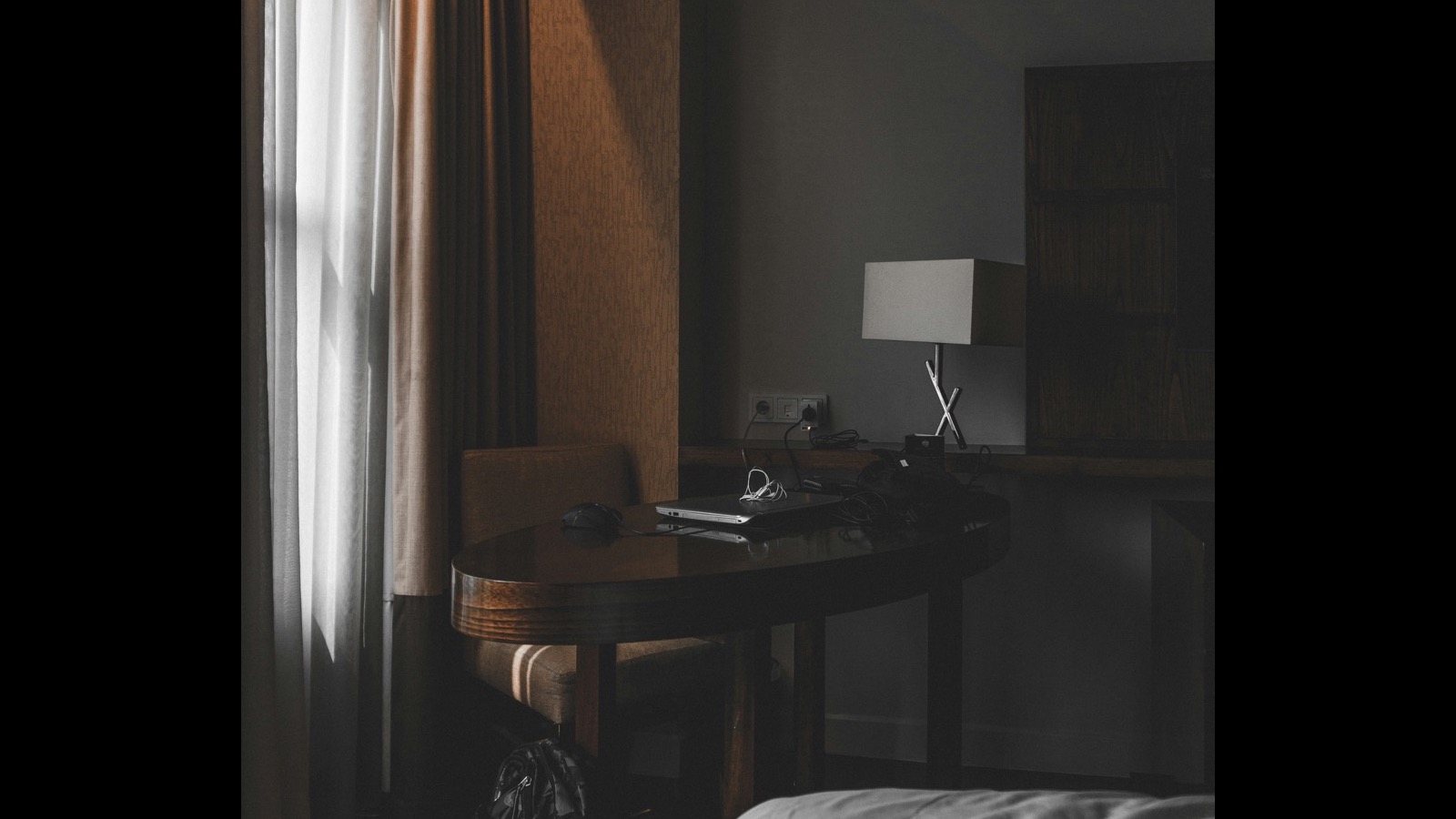
You check into the hotel exhausted. The bed looks great, the pillows are fluffy, the room is quiet. You switch off the light, close your eyes... and lie there. Wide awake. Then you finally drift off, only to surface at every small sound, and wake at 5am feeling like you barely slept.
It's tempting to blame the mattress, the pillow, or the "wrong" side of the bed. But the real reason you sleep badly somewhere new is more interesting: your brain doesn't fully trust the new room yet, so part of it stays on watch while you sleep.
Sleep researchers have a name for this. It's called the first-night effect, and it happens to healthy people in perfectly comfortable beds all over the world. The good news? Once you understand what's happening, you can do a lot about it.
TL;DR: The first-night effect is a real, well-documented phenomenon where sleep in an unfamiliar place is lighter, more fragmented, and harder to fall. Brain imaging shows why: on the first night somewhere new, a network in one brain hemisphere stays more vigilant than the other, acting like a night watch that responds faster to unusual sounds. It's a survival mechanism, not a sign that something is wrong with you or the bed. It usually lasts one night. To sleep better away from home: bring small pieces of your home routine with you, darken and cool the room, mask unfamiliar noises with white noise or earplugs, keep your normal bedtime, skip the "nightcap," and don't stress about the first rough night — your wearable will probably agree with you by night two.
YouTube: Related video
The first-night effect is real, and researchers have known about it for 60 years
Scientists didn't discover the first-night effect in hotels. They discovered it in sleep labs, where it was a nuisance.
Back in 1966, researchers Agnew, Webb, and Williams published one of the first EEG studies showing that volunteers slept noticeably worse on their first night in the lab: they took longer to fall asleep, woke more often, and got less of the deep, restorative sleep stages. The effect was so consistent that it became standard practice to throw away the first night of data in sleep studies. Participants get an "adaptation night" to get used to the equipment and the room, and only the second night counts.
That's a striking fact. These were healthy young people lying in a comfortable, controlled environment with nothing to fear. Their sleep still fell apart on night one, purely because the place was new. If it happens to sleep-lab volunteers in a boring clinical room, it's definitely going to happen to you in a hotel.
Roughly half of people experience it to some degree. For some it's mild, a slightly longer time to fall asleep. For others it's a genuinely bad night.
Why your brain refuses to fully switch off
For decades, researchers assumed the first-night effect was just anxiety or unfamiliarity. Then in 2016, a team at Brown University showed something stranger.
Using brain imaging and EEG, they scanned volunteers sleeping two nights in the lab, a week apart. On the first night, they found an asymmetry: a specific network in the left hemisphere, the default-mode network, showed lighter, shallower slow-wave sleep than the same network on the right. One side of the brain was sleeping more deeply than the other.
And that vigilant hemisphere was actually doing a job. When the researchers played soft, irregular sounds during deep sleep, the "awake" hemisphere responded faster and was more likely to wake the person than the other side. On the second night, the asymmetry was gone and so was the hyper-alertness.
In other words, on the first night in a new place, your brain runs a local night watch. It keeps a patch of cortex slightly more alert, tuned to unusual sounds and potential threats, in case the unfamiliar environment turns out to be dangerous.
We're not alone in this. Some birds and marine mammals literally sleep with one hemisphere awake at a time, so they can watch for predators while resting. Humans don't usually need that — but when we're somewhere new, the brain seems to borrow the same trick in miniature.
Here's the part worth sitting with: your brain can't tell the difference between a cave with unknown predators and a nice hotel room. It just registers "unfamiliar place" and deploys the night watch anyway. The Marriott isn't dangerous, but your brain doesn't know that yet.
What the first-night effect does to your sleep (and your wearable data)
On a practical level, the first-night effect shows up in a few predictable ways:
- Longer time to fall asleep. Your brain is in "monitoring" mode, so winding down takes longer.
- Lighter sleep. More time in light stages, less deep sleep, especially early in the night.
- More awakenings. You surface at noises you'd sleep through at home: the elevator, the ice machine, traffic, a door down the hall.
- Lighter, more vigilant REM. The night watch can intrude even into dream sleep.
Now add a wearable to that picture, and you'll see exactly what you'd expect: a lower sleep score, more wake-ups logged, sometimes a slightly higher resting heart rate or a dip in HRV. If you use Century AI, your health score will likely take a small hit that morning, and your first instinct will be to panic.
Don't. Here's the important part: this is a normal, expected reaction to a new environment, not a sign that you're broken, overtraining, or secretly sick. A single bad night is noise; what matters is the trend. If your sleep score bounces back on night two and your HRV follows, the first night was just your brain doing its job.
The bigger risk isn't the bad night itself. It's obsessing over it. Fixating on a low score, checking your sleep stages at 2am, and mentally calculating how wrecked tomorrow will be makes everything worse — that's the trap we cover in detail in our piece on orthosomnia, the anxiety that comes from over-tracking sleep.
How long does it last?
Usually one night. The Brown University study found the brain's asymmetry was essentially gone by the second night, and people fell asleep faster. If you're staying somewhere for a few nights, night two is normally much better, and night three is usually back to your baseline.
A few caveats:
- Every new bed resets the clock. If you're doing a tour where you change hotels every night, you may feel like you never adapt. You're not a bad sleeper — you're sleeping in a new place every single night.
- Bigger novelty means a bigger effect. A tent in the woods, a friend's couch, or a hotel in a very different time zone can all amplify it.
- Jet lag stacks on top. When your circadian rhythm is also out of sync, you get the worst of both. That's why our travel and jet lag reset guide is the right companion read before any big trip.
That last point has a practical consequence for anything important: if you have a big presentation, a race, or a wedding, arrive a day early. Give yourself the bad night on night one, when the stakes are low, so you're sharp when it matters.
How to sleep well in a new place: the practical playbook
You can't switch off the night watch with a button. But you can make it unnecessary, or at least irrelevant, by shrinking the gap between "new room" and "safe room." Here's what actually works, based on the sleep-environment research and what sleep specialists recommend:
| Problem | Fix |
|---|---|
| Novel sounds wake you | White noise app or earplugs. Masking unfamiliar noises is one of the most effective things you can do. |
| Light leaks in | Use the blackout curtains properly (clip the gap), or bring a sleep mask. Darkness is a strong "safe to sleep" signal. |
| Room too warm | Crank the AC down. You sleep best when the room is cool, around 18–19°C, which most hotel thermostats can manage. |
| Bed feels wrong | Bring your own pillowcase (or an entire pillow if you're driving). Familiar scent and feel help your brain register the bed as yours. |
| Evening feels off | Do your normal wind-down in the same order: same shower, same tea, same reading or podcast. Routine is a sleep cue your brain trusts. |
| You're wired from travel | Keep lights low in the evening and get bright light in the morning, ideally outside, to anchor your body clock to the new schedule. |
A few more that don't fit neatly in a table:
- Keep your usual bedtime. It's tempting to stay up late when you're away, but the first-night effect already makes falling asleep harder. Don't stack a shifted schedule on top of it.
- Skip the alcohol "nightcap." A drink helps you fall asleep, then fragments the second half of the night and raises your overnight heart rate. If you're already sleeping badly in a new place, alcohol makes the bad night worse.
- Unpack a little. Clothes in the wardrobe, toothbrush out, water on the nightstand. It sounds trivial, but it signals "I live here now" to a brain that's scanning for novelty.
- Do a 5-minute safety sweep. Check the door is locked, figure out the light switches, look out the window. Knowing the room holds no surprises removes the vague vigilance that keeps the night watch active.
- If you wake up, don't fight it. Lie still, keep the lights off, and let your body settle. Getting up, turning on lights, or grabbing your phone tells your brain "we're awake now," which makes returning to sleep harder. And whatever you do, don't check your sleep score mid-night.
Why some people sleep better in hotels
The first-night effect isn't universal, and here's the twist: a meaningful number of people sleep better away from home. Their wearables show higher scores in hotels, not lower.
Why? Usually because home has become the problem. If your bedroom is where you watch TV, scroll, stress about work, and lie awake worrying, your brain has learned to associate that bed with wakefulness. Sleep doctors call it conditioned (or psychophysiological) insomnia: the bed itself becomes a trigger for alertness.
A hotel room has none of that baggage. There's nothing to do there but sleep, no mental to-do list attached to the pillow, no history of restless nights. For those people, the novelty works in reverse — the unfamiliar room is a clean slate, and the vacation effect takes over.
If that sounds like you, the first-night effect article you actually need is about your bedroom at home, not your hotel room. The fix is the same science in reverse: make your bed a place for sleep and nothing else, keep it dark and cool, and build a wind-down you can repeat anywhere. (Our guide to understanding your sleep score walks through what your watch is really measuring on those good and bad nights.)
Summary
- The first-night effect is real and normal. Roughly half of us sleep worse in a new place, and sleep labs have known about it since 1966.
- Your brain runs a night watch. On night one somewhere new, part of the left hemisphere stays more vigilant during deep sleep, primed to wake you at unusual sounds. It's a survival mechanism, not a flaw.
- Expect one bad night, not a bad trip. The effect usually disappears by night two, so arrive a day early when the next day really matters.
- Your wearable will confirm it. Lower sleep score, more wake-ups, a small HRV dip. That's expected — judge the trend across the trip, not the first morning.
- Shrink the novelty. Bring familiar items, replicate your wind-down, darken and cool the room, and mask strange noises with white noise or earplugs.
- Skip alcohol, keep your bedtime, and don't check your score at 2am. The less you fight it, the faster the night watch stands down.
- If you sleep better away from home, the problem is probably your home bedroom's sleep associations, not your sleep.
The next time you stare at a hotel ceiling at 1am, remember: it's not the mattress, and it's not you. It's an ancient alarm system doing exactly what it evolved to do. Give it one night, take the edge off with a good sleep environment, and by tomorrow your brain will have filed the room under "safe" — and you'll sleep like you're home.
Century AI helps you understand your body with a daily health score, recovery score, and sleep insights — using the watch you already wear.